Every Gym Has the Same Dumbbells
By Pankaj Nathani on July 29, 2026
Walk your own gym floor and count what the money bought. The racks. The plates. The pin-loaded machines, the cardio row, the flooring that cost more than a car. On the floor, a gym is a hardware company, and every other gym bought the same hardware, mostly from the same catalogues, often from the same rep. Equipment used to be a moat; now the gear is excellent everywhere, and whatever booms next is across the road within a year.
And the floor is only the part of the ledger you can see. The rest of the money went to things members never touch: the franchise fee and the royalties that follow it, the fit-out, the branding package, the training courses for staff, the payroll for the people who run the desk and chase the failed direct debits. Line after line, all of it buying the same thing the dumbbells buy: the venue, and the right to operate it.
Now find the line where the money bought the thing members actually stay for: a coach who knows them, a program that fits their week, somebody who notices when they start to fade. On most ledgers it's the smallest line. On plenty of them, it isn't a line at all.
Nobody keeps a membership for the dumbbells, and nobody renews for the fit-out or the sign, either. The hardware, the whole ledger of it, is the venue. The coached relationship is the product.
If that sounds like a stretch, consider what the best hardware company in fitness just did with its money.
What Garmin bought
Last week (July 2026), Garmin acquired TrainingPeaks and TrainHeroic, the platforms where endurance and strength coaches run their coaching businesses. It came the same week Garmin launched a screenless band aimed squarely at Whoop, a fight that tells you where wearable hardware is heading: every device measures the same body, and the sensors are all good now.
Garmin can manufacture almost anything. What it bought is the one thing its factories cannot produce: the installed base of relationships between human coaches and the athletes they train, and the platforms that carry those relationships. Garmin's own announcement says what it paid for: "authentic coaching experiences," "connecting athletes with professional coaches." Not sensors. Relationships. The number isn't the point; the direction of travel is.
If the company with the best hardware in fitness has decided the product is the coached relationship, the question is what the companies with the most hardware, gyms, are going to do about it.
The gym version of the mistake
In much of the market, personal training runs as a sublet. The trainer rents floor space or splits sessions with the house. Clients get booked through the trainer's personal WhatsApp. Programs live in whatever app the trainer prefers, or in a spreadsheet, or on paper. Progress photos, check-ins, the whole history of the relationship: on the trainer's phone.
Look at that arrangement through the Garmin lens. The gym owns the squat racks, and collects rent on the one layer of the business that a hardware company just went shopping for.
Plenty of operators employ their trainers instead, and feel safely past this problem. Often it changes less than it seems, because employment is not ownership. Systems are. An employed coach running clients through a personal phone leaves the same hole; the payroll status of the person holding the phone doesn't change whose relationship it is. When that coach leaves, employed or not, the clients, the records, the conversation history and the habit leave too.
Ownership is a systems question
Whenever a gym starts taking coaching seriously as a business, four questions surface. Who employs the coach. Who owns the client list. Whose systems carry the coaching. How the money splits.
The first, second and fourth are business-model choices. They vary by operator, they involve lawyers and award rates, and they are not our lane. The third one is, and it quietly decides what the other three are worth.
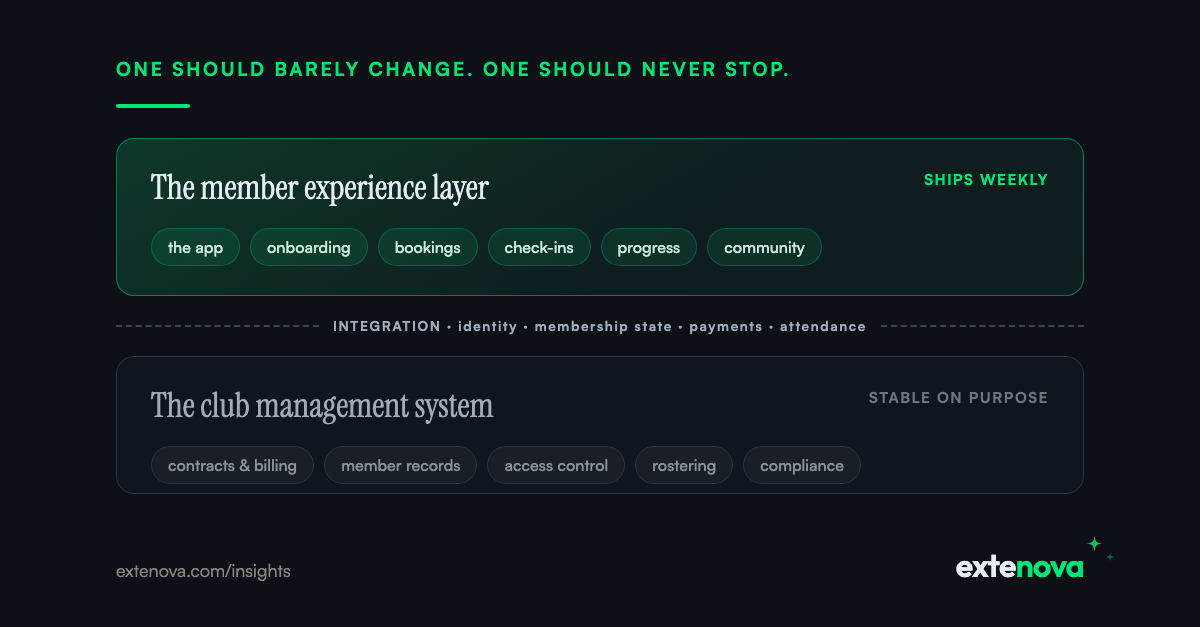
A gym owns the coach relationship only if the coaching runs on the gym's platform. The bookings in the gym's system. The check-ins landing in a console the gym operates. The client records, program history and messaging living in infrastructure that stays when people go. Not because any of this restrains the coach, but because it is what makes the relationship part of the business rather than an arrangement that happens to occur on the premises.
There is a simple way to test where you stand.
The departure test. When your busiest coach resigns, what leaves with them? If the answer is the clients, the records, the conversation history and the habit, then you never owned a coaching business. You owned a room where coaching happened.
Run the test honestly and most operators find they are somewhere in the middle: memberships in the club system, coaching everywhere else. The fix is not a policy memo telling coaches to stop using their phones. Coaches use their own tools because those tools are better than what the gym provides. The fix is a platform good enough that the coach prefers it: scheduling that respects their day, a check-in queue that saves them time, client records that make them look thorough. Make the gym's system the easiest place to be a great coach, and the ownership question answers itself. The coaching gets better and the business gets to keep it. Members, who stay for adherence rather than access, get a relationship that survives staff turnover instead of dying with it.
The layer that compounds
Hardware depreciates from the day it lands on the floor. The coached relationship compounds: every booking, every check-in, every recorded session deepens something the business owns, provided the business actually owns it. That is the asset Garmin decided was worth buying, and gyms are sitting on the same choice with better raw material, because their coaches and members are already in the same room.
The equipment was never the product. The venue was never the product. The relationship is the product, and it accrues to whoever's systems carry it.
Which layer do you own?
Get the next piece
We write about the technology side of running a fitness business: member experience, retention, and what's worth building versus renting. No spam, just signal.