Your Gym Management System Was Never Meant to Be Your Member Experience
By Pankaj Nathani on September 23, 2026
Most conversations we have with gym operators about member experience begin with frustration at their club management system. The app is dated, the booking flow is clunky, members are complaining, engagement is flat. Usually someone has just scrolled the app across the meeting table. And at some point, someone says the expensive sentence: maybe we need to rip it all out and start again.
After a decade of building member platforms, including ones that sit alongside these systems, our answer is almost always the same. The club management system is not failing. It is being asked to do a job it was never designed for.
Two different jobs
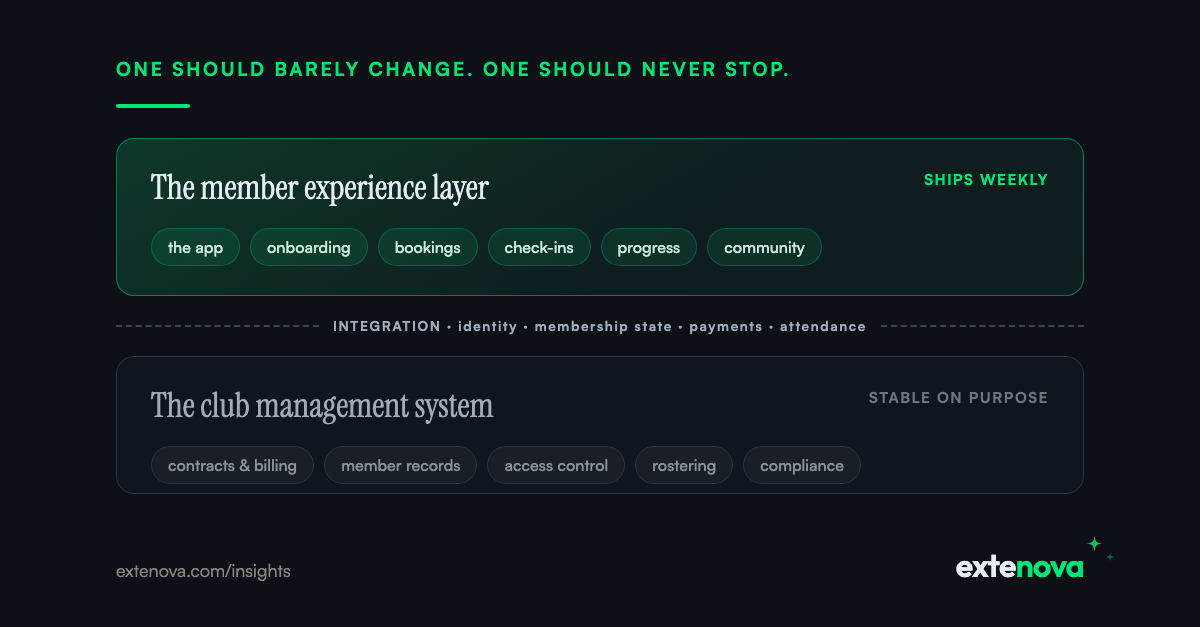
A club management system exists to run the business of membership: contracts, direct debits, arrears, door access, rostering, reporting. Software in this class is transactional and mission critical. When it fails, revenue stops. Its virtues are stability and accuracy, and its pace of change is deliberately slow, because you do not want creativity in the system that debits forty thousand bank accounts on a Monday morning.
A member experience is a different thing entirely. It is the app a member opens on the couch at 9pm, the plan that tells them what tomorrow is for, the booking that takes two taps, the check-in a coach responds to, the streak that makes progress visible. Its job is a relationship, not a transaction. And relationships demand the opposite virtues: responsiveness and constant evolution, because member expectations are set by the best consumer apps on their phone, not by the fitness industry.
One kind of software should change as rarely as possible. The other should never stop changing. Ask a single system to be both and one side gets shortchanged. In practice it is the member side, because the contract renews on the plumbing.
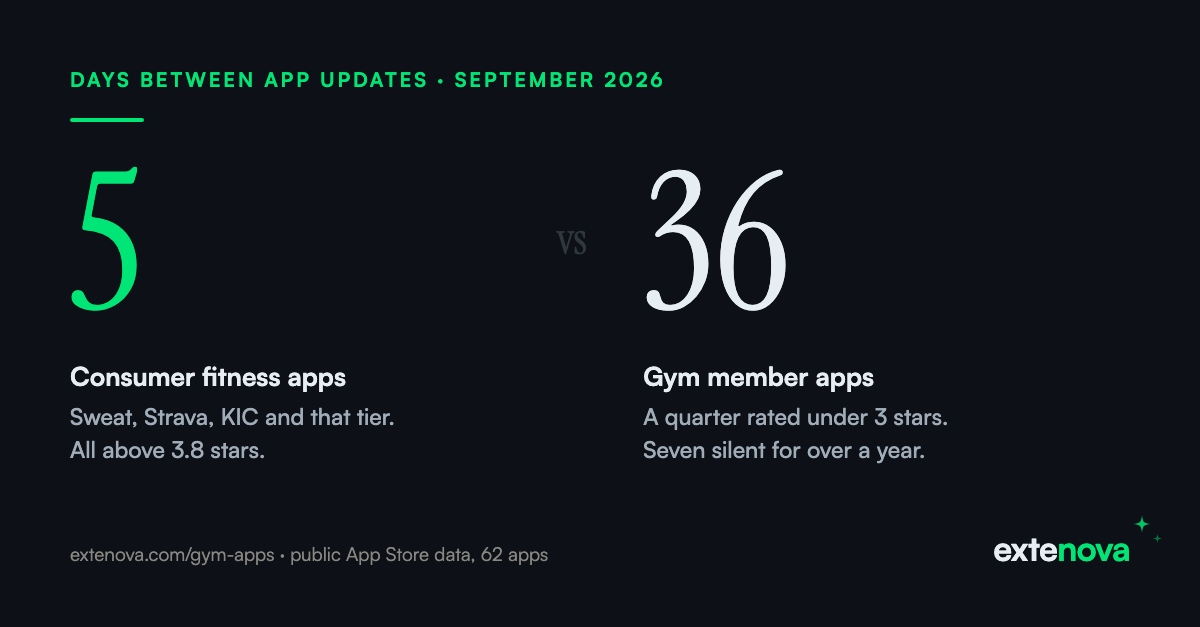
That is no longer just our observation. We measured it. Across the 44 gym and studio member apps in The Gym App Index (September 2026 refresh), the median gap between App Store updates is 36 days, and a quarter of those apps are rated below three stars by their own members. The consumer fitness apps sitting beside them on the same phones ship every five days. That gap is what "the member side loses" looks like in public data.
The rip-out reflex
When frustration peaks, the instinct is total replacement. It is also the most expensive possible mistake, for three reasons.
First, the migration risk lands on the plumbing. Contracts, payment mandates, member records and access control are precisely the things you cannot afford to break, and a full replacement puts all of them in motion at once to fix a problem that lives in none of them.
Second, the new all-in-one will disappoint the same way the old one did, for the same reason. A year and a small fortune later, you will have exchanged one compromise for another.
Third, the disruption is aimed at members, the one audience the project was meant to serve. Every login change, every re-registration, every "please download our new app" email spends goodwill that took years to earn.
The consolidation pitch
The platform vendors' answer to all this, increasingly, is consolidation: more capability under one roof, one vendor, one contract. The acquisitions run in that direction, and so does the sponsored analysis in the trade press, where fragmentation is named as the enemy and one connected platform as the cure.
Half of that argument is right. Fragmented data genuinely is a problem, and the line the vendors like most, that automation and AI are only as good as the data they run on, is true. But connected does not mean consolidated. An operational core with open APIs, feeding a member layer built on top of it, produces exactly the connected data the argument calls for, without handing the member relationship to the same contract that runs the billing. The question is not how many systems you have. It is whether the layer that carries the relationship carries your name, keeps your member data yours, and evolves at the member's pace, or sits as a module inside the billing contract.
It says something that this October, the industry's own technology summit is running a session on precisely this: innovating on top of the core you depend on, rather than ripping it out. The conversation has moved. The all-in-one era framed the choice as which system does everything. The better question is what to keep as the core, and what to build on top.
Meaningful data comes from the member layer
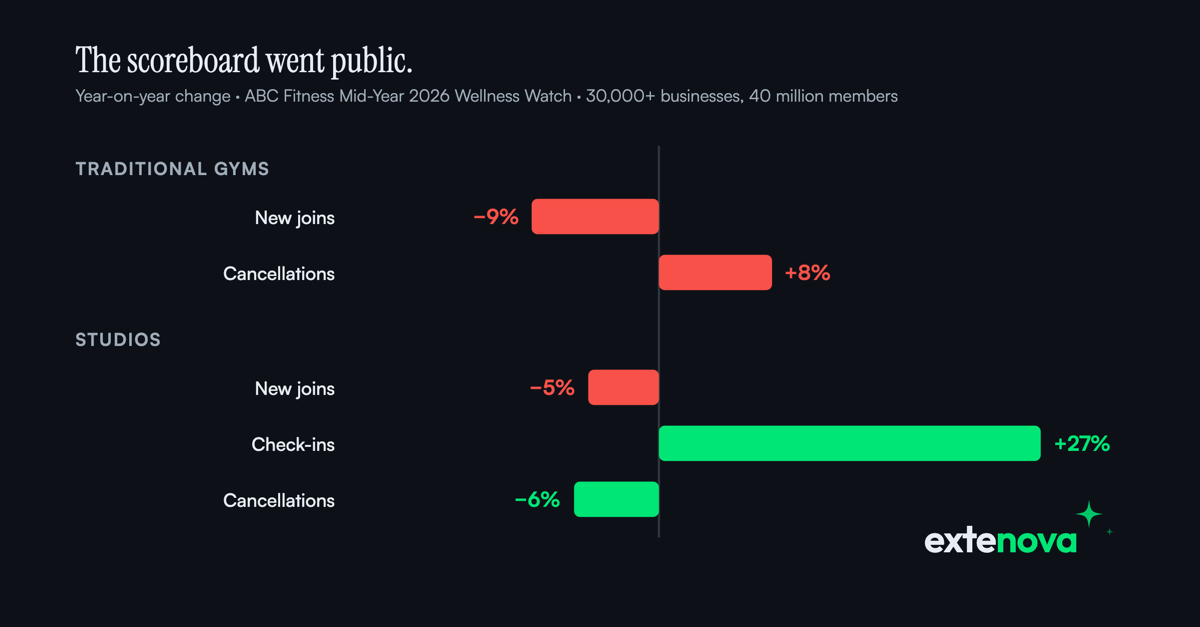
A club management system records transactions: the debit cleared, the door opened, the contract renewed. All real information. All of it arriving late. By the time trouble shows up there, it is a cancellation.
The member layer sees behaviour: bookings that stop, a streak that breaks, plans that stop being opened. The member whose visits are stretching out is invisible to the billing system, because the debit still clears, and obvious to the layer that carries engagement. That is what the member layer actually is: not a convenience sitting on top of operations, but the retention layer, the only place the early signals exist and the place that can route them to a human while there is still time.
The unstaffed hours make this concrete. In a 24/7 market like Australia's, most of a club's operating week has nobody rostered, so whoever a member meets at 11pm is software. The prospect who signs up online at 9pm on a Sunday meets only that layer. Whether they train that night with a mobile pass, or wait until Wednesday to collect a fob during staffed hours, is decided by software, not by the door.
Club management systems were never built for any of that, and it is no criticism of them to say so. It is simply the clearest illustration of the two jobs: one system keeps the doors working, another keeps the people coming through them.
What belongs where
A rough sorting, from years of drawing this boundary:
The club system keeps: contracts and billing, member records as the source of truth, access control, rostering and payroll, compliance reporting.
The member layer owns: the app itself, onboarding and the first-week experience, training and class content, bookings as the member sees them, progress, streaks and check-ins, community, messaging and the signals that tell a human who needs attention.
The integration carries: identity and sign-in, membership state and entitlements, payments where members purchase inside the app, and attendance data flowing back so both layers see one truth.
Draw the line there and each layer can be judged by the right standard: the core by reliability, the member layer by whether members keep coming back, the integration by whether nobody ever notices it.
We would say all this, since the member layer is the only thing we build, custom for a chain or as our own platform under its name. But the argument is architectural, not commercial, and operators who have lived through a rip-out tend to arrive at it on their own, one expensive lesson later.
Three questions before you sign anything
If you are evaluating a platform decision this year, the feature matrix will not tell you much. These will:
- Which of our problems actually live in the club system, and which live in the member's hand?
- If we replace everything, what breaks for members on day one, and what does that cost in goodwill?
- If we keep the core and add the layer on top, what could members have in six months?
The chains getting this right are not the ones with the newest system. They are the ones who stopped asking one piece of software to be two things.
Get the next piece
We write about the technology side of running a fitness business: member experience, retention, and what's worth building versus renting. No spam, just signal.